Doing Nothing For Now
If your door is opening and closing without grinding, jumping, or hanging up, you probably don't need a call yet. A lot of Huntington Beach homeowners hear a squeak and assume the worst, but most of the houses in this part of the county were built between 1953 and 1995, with the median landing around 1968. That means the hardware on your door has had decades to loosen a little at a time - a squeak is usually a roller or hinge bolt asking for grease and a quarter turn, not a spring about to let go. Waiting a week to see if the noise gets worse costs you nothing. Waiting through a full binding or scraping sound does. The honest limitation here: we can't tell you over the phone whether your noise is the cheap fix or the expensive one. Some things you can leave alone; a door that's started dragging on one side generally isn't one of them, and that's the line worth watching for.
What to Look At First
On a house from the 1960s or 70s stock that makes up most of this area, the first thing a technician looks at isn't the opener - it's the track alignment and the spring anchor bracket. Original construction from that era commonly used lighter-gauge track and single anchor points that have carried 50-plus years of thermal cycling. We check bracket screws for stripped holes, look at the bottom of each track section for rust bloom at the weld seams, and test cable tension on both sides, not just the side that's making noise. If the door has ever been repainted or the panels replaced piecemeal, we also check that the new panel weight actually matches the spring size - a mismatch here is common in homes with older frames and newer doors bolted onto them, and it's an easy thing to miss without opening the panel.
How Local Conditions Play In
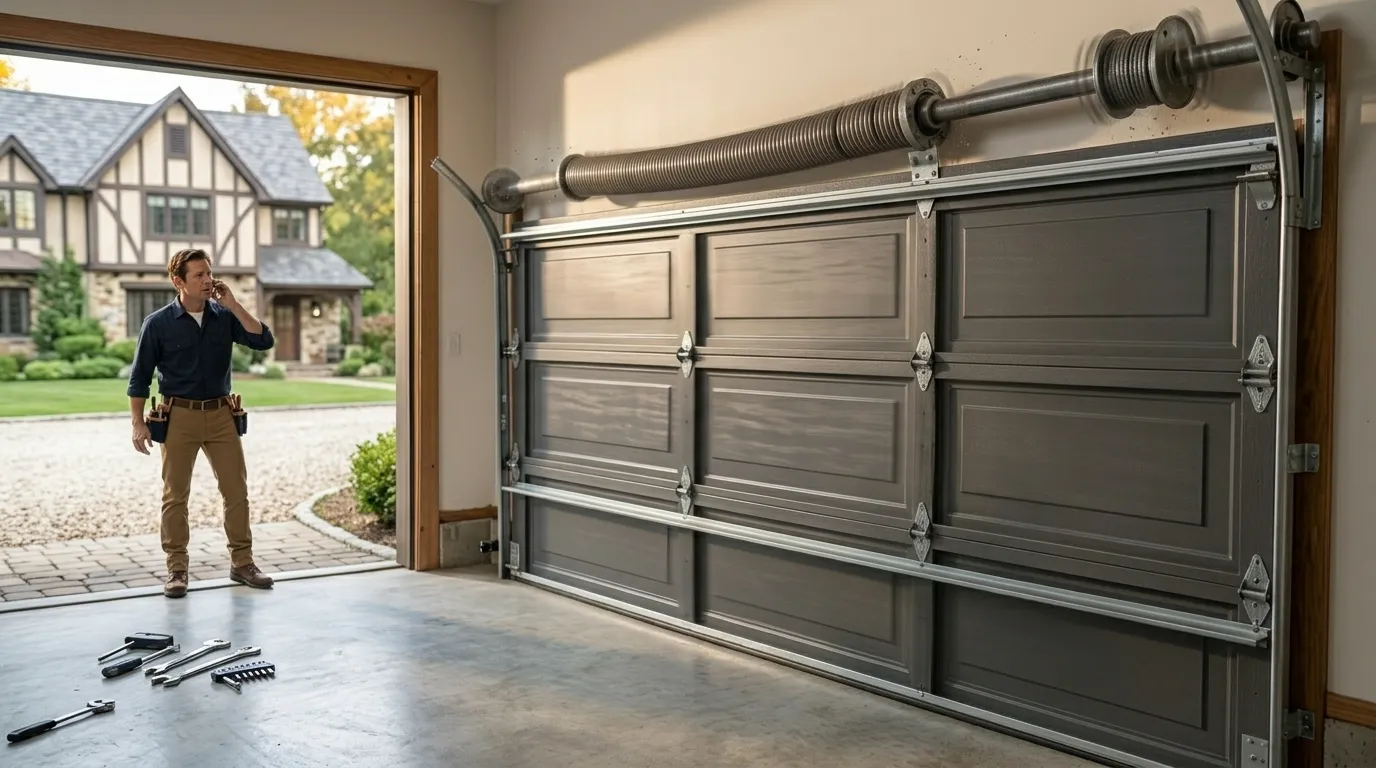
Huntington Beach sits in a mild temperate band, so we're not chasing the freeze-thaw cracking or the extreme heat warping you'd deal with further inland. That's good news for the door itself, but it shifts where the wear actually shows up. Salt-laden coastal air moving in from the direction of Sunset Beach, about 4 miles WNW, accelerates corrosion on exposed hardware - hinges, springs, and unpainted brackets - faster than the temperature swings do. A technician checks for surface rust on spring coils and cable ends before checking anything else mechanical, because in this climate the failure mode is more often corrosion-driven metal fatigue than the sudden stress cracking you'd see somewhere with real winters. Weatherstripping and bottom seals also wear from constant marine moisture rather than from ice, so we look at seal pliability, not seal cracking.
The Problem
Put those two things together - 1960s-70s hardware and steady coastal humidity - and the actual problem on most calls here is quiet corrosion on parts that were never built to last this long in the first place. A torsion spring rated for a certain cycle count doesn't care how mild the weather is; it cares how many times it's compressed and released, and a 50-year-old spring on original hardware has usually put in more cycles than its design life anticipated. We're not going to tell you every older door needs full replacement - plenty of them just need the corroded hardware swapped for stainless or galvanized equivalents and they're fine for years more. But if the anchor bracket is stripped and the track is pitted at the seams, patching the noisy part and leaving the rest is the kind of fix that gets you a second call within the year.
Talk to a local pro
Garage door trouble in Huntington Beach?
Same-day service with honest, upfront quotes.